
So, you built a clinical scheduling system, and you deployed it to your first client. you can do C-R-U-D, you got a slick iOS app launched- great work! You've made it farther than many.
Now, let's take that system and deliver it to several more healthcare facilities. How about 100 more? Let's see how it goes!
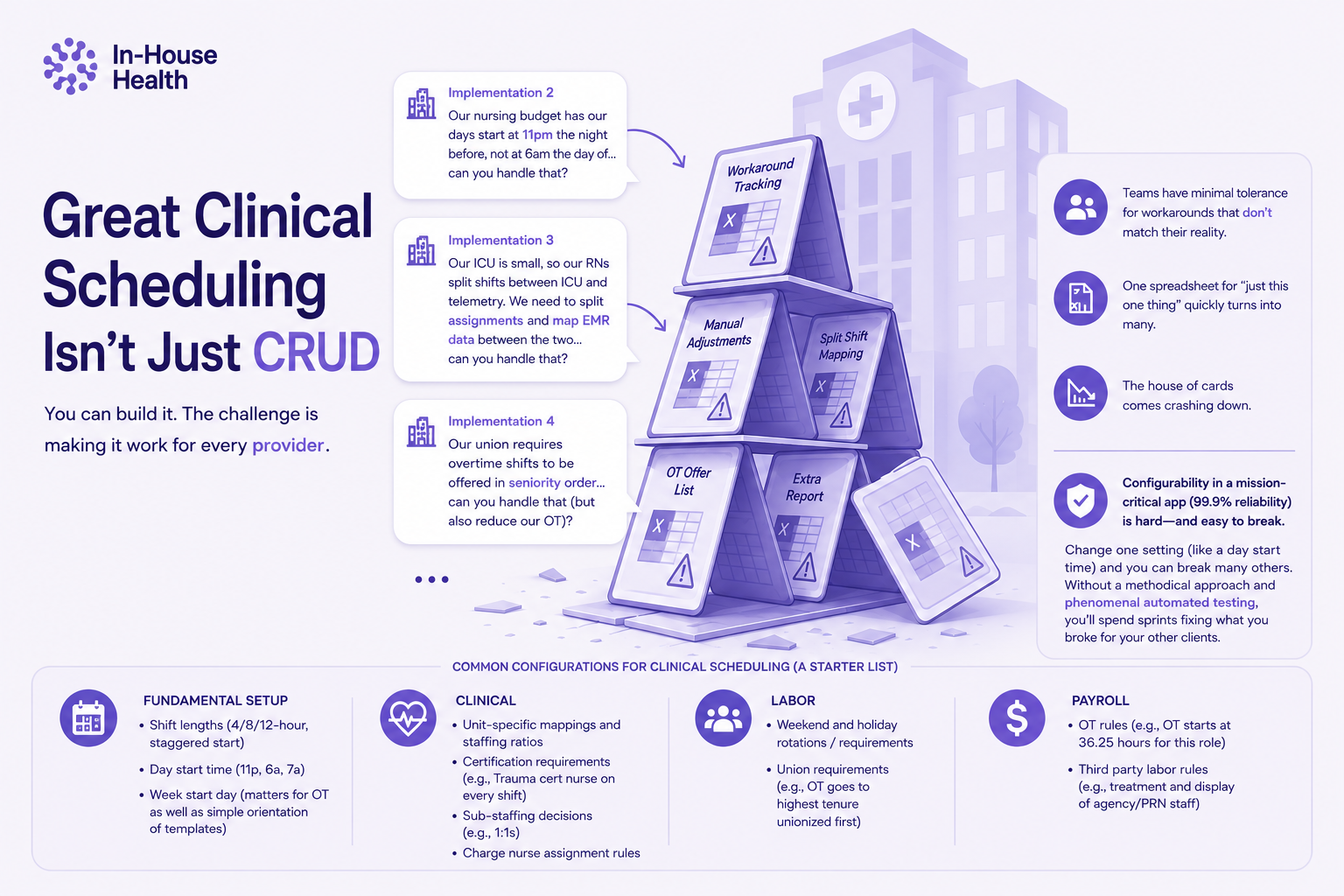
Implementation 2 says: "Our nursing budget has our days start at 11pm the night before, not at 6am the day of... can you handle that?"
Implementation 3: "our ICU is fairly small, so our RNs on that unit split shifts between ICU and telemetry, so we need to split assignments and also map the EMR data between the two... can you handle that?"
Implementation 4: "Our union requires overtime shifts to be offered in seniority order... can you handle that [but also reduce our OT]?
And so on.
Configurability is king. If you can't do it, guess what, the team you dreamed of digitizing and saving time and money... is back on spreadsheets. Their tolerance for workarounds and tech that only "mostly" matches their reality is minimal. Fail to match their world, whether it's clinical or administrative requirements, the team is busy doing other things (e.g., caring for patients), and they'll be back in Excel in no time. even with the best of intentions, once there are a few "oh yes we can't handle X", a spreadsheet gets created to track X, and once you've got one spreadsheet, another shows up, and the house of cards begins to fall.
And, configurability—in an App that must be 99.9% reliable, since clinical scheduling is —is hard to accomplish. Starting the days at 11pm breaks a bunch of other configurations. Starting the day at 11pm and having different standard shift lengths breaks even more. If you're not careful, well planned and technically methodological, you'll spend the next 2 development sprints fixing everything you broke for clients 1-6 deploying the system for client 7.
So, if you want a scaled scheduling system, serving many different types of nursing teams with different requirements, you better be ready with some phenomenal automated testing that makes sure your latest configuration didn't bring the house down around it
--
Common configurations for clinical scheduling (a starter list)
Fundamental setup
Shift lengths (4/8/12-hour, staggered start)
Day start time (11p, 6a, 7a)
Week start day (matters for OT as well as simple orientation of templates)
Clinical
Unit-specific mappings and staffing ratios
Certification requirements (e.g., Trauma cert nurse on every shift)
Sub-staffing decisions (e.g., 1:1s)
Charge nurse assignment rules
Labor
Weekend and holiday rotations / requirements
Union requirements (e.g., OT goes to highest tenure unionized first)
Payroll
OT rules (e.g., OT starts at 36.25 hours for this role)
Third party labor rules (e.g., treatment and display of agency/PRN staff)
Written by
Ari Brenner
Share us on
AI-driven Scheduling and Management Platform for Modern Nursing Teams
Schedule a Demo

Get out of spreadsheets and back to the bedside
Free opportunity assessment for your organization